My adventures as a Peace Corps volunteer in the Federated States of Micronesia.

Thursday, July 17, 2014

Boyz II Men (Not the 90s band)

I made it through my third camp of the year, this time for 8th grade boys. Surprisingly, it went better than either of the girls’ camps. This was surprising first because we planned it at the last minute, and second because it was for 8th grade boys. I expected lots of behavior problems, but the boys were great (it helped that we had less than 30 boys, whereas the girls’ camps had 60 and 70 each). Plus, this camp was the most fun because the boys got so into the teamwork and leadership games. The enthusiasm was just off the charts.

The gang
Human knot
Acid river: cross without touching the ground!
BoyzIIMen focused on five pillars: respect, community service, leadership, teamwork, and ambition. We also had some peer educators from the high school talk about drugs and HIV/AIDS. They brought ukuleles and sang some awesome songs – the boys were singing the “say no to drugs” song on the bus ride home!

Improvised CPR lesson
Discussing goals
The best part of the camp was our evening bonfire. We introduced the all-American s’more, which was a huge hit (how could it not be?), and glow sticks (which I guess would have been more appropriate for the girls’ camp, considering it’s called Camp GLOW).


This camp served as a “pilot program” for BoyzIIMen on Pohnpei (we got the framework from the Chuuk volunteers have been doing it for several years), so hopefully next year the remaining Pohnpei volunteers will be able to expand the program to more schools. 

Summer Science

We’re halfway through my last Peace Corps project! It’s a cross between summer school and day camp that focuses on hands-on science. Unfortunately, science in Pohnpei is very textbook-focused due to a lack of materials and teacher training. My principal is trying to get more support from the Department of Education, but in the meantime I decided to give the students and some of the interested teachers an introduction to scientific experiments. It’s nothing fancy – just a very rudimentary overview of the scientific process and some fun experiments.

We’ve already conducted classes for 5-7th grade, and during the next two weeks we’ll be focusing on 2nd-4th grade. I originally was going to teach a computer class for the 7th graders, but the computers aren’t working (what else is new?). They were disappointed, so I they joined in first week and they served as my assistants the second week.

(By the way, a huge thank you to those of you who donated money for supplies!)


Here are some of my favorite pictures from the first two weeks:

Learning about density by layering liquids
Gak! Is it a solid or a liquid?
Neither! It's a POLYMER!
Landslide simulation
Egg drop experiment!
Explosive baking soda and vinegar volcano! (Probably the
most popular experiment of all)

Wednesday, June 18, 2014

Extreme Camp GLOW

This year the Pohnpei volunteers continued the Camp GLOW tradition for 8th grade girls. GLOW stands for "Girls Leading Our World," and the camp is all about women's health and empowerment. This year we did two separate camps since we had so many girls that wanted to join. Needless to say, it was a LOT of work and I'm relieved that we survived two camps! But it was also lots of fun :)
Camp 1 for the east side of the island. 
Camp 2 for the west side
We led club sessions at our schools throughout the school year on puberty/menstruation, HIV/AIDS, teen pregnancy, rape and sexual abuse, healthy and abusive relationships, substance abuse, leadership, and diabetes and staying healthy. These topics are all especially important on Pohnpei where teen pregnancy is a huge problem, one third of the population has diabetes, and domestic abuse is prevalent. Plus there's no sex ed on the island, so most of the girls had never had the "sex talk" before. Then at camp we did group activities involving these topics and invited guest speakers to join in the conversation. (Shocking things we learned from a local lawyer: the age of consent in Pohnpei is only 15, and only 13 in Chuuk. Also, marital rape is not illegal. Luckily the Pohnpei Women's Council is working hard with the legislature to change these laws.)

Learning CPR
Kelly Jo and Aidee demonstrate condom use on a cucumber
The International Organization for Migration came to talk
about natural disaster preparedness and the girls learned how
to start a generator, among other activities.
The girls show off the local baskets that they wove from palm fronds
My 11 GLOW girls from Pehleng Elementary, plus my two
fabulous co-teachers :)
Overall, the two camps were huge successes, aside from one night when the volunteers got no sleep ("Girls, get OUT of the showers and BACK in bed. It is 4 o'clock in the morning!!") and one medical emergency.

Next up, a boys' camp in July! (By the way, it will be called "Boyz 2 Men," not "BLOW," despite the wishes of my co-teachers. I had to explain the English connotation to them...)  Hopefully I'll have my energy back by then!

Island Style

Aside from sakau, embroidered skirts (urohs en Pohnpei) may be the most quintessentially Pohnpeian symbol. Every Pohnpeian woman owns a collection of these skirts – simple embroidery for everyday wear and elaborate embroidery for special occasions, feasts, trips into town, etc. 

At Education Day last year - the four of us on the ends are wearing
different styles of Pohnpeian skirt


Several of my family members make these skirts for a living. Since all my medical problems this winter, I haven’t been going up to the mountain to harvest sakau anymore – instead, I’ve been filling most Saturdays helping Seileen make skirts. 

Seileen and Pattiann work in their "skirt factory"
She does all the sewing, but I’m responsible for the cutting. The nicest skirts (the ones that sell for the most money) involve three layers of fabric, and I cut around all the embroidery to expose the colored fabrics in the 2nd layer. It takes about 1-2 hours per skirt, and it’s a nice way to fill those weekend hours!

The middle skirt is an example of the layered cutting technique
(the orange fabric is the 2nd layer)
The other key element of a Pohnpeian woman's wardrobe is the oh-so-figure-flattering muumuu. It seems like they should be breezy and comfortable, but I find them unbearable to wear in the hot weather. I have to wear them to school and church, but I also change into Pohnpeian skirts as soon as I get home!

Matching muumuus are popular. People use the
English word "uniform" when their clothes match

Pohnpeian Legends

Earlier this year my 7th graders retold Pohnpeian legends in English and Pohnpeian. Here's a sampling...

The Legend of Sapwkini
Retold by Venniesha and Santiago
Long, long ago there was a man named Sapwkini. One day he was sitting and thinking of something to do. He wanted to see an island, so he built a big canoe.
He sailed and sailed on the ocean. One day, Sapwkini met an octopus named Lidakihki. Lidakihki asked Sapwkini, “Where are you going?” And Sapwkini said that he wanted to find an island. Lidakihki showed him a reef, but the reef was too small. So Sapwkini went back home.
He told his friends to bring their canoes and rocks and soil. They all went back to the little reef and built an island with the rocks and soil. Sapwkini named the island Pohnpei.

The Legend of Isokelekel
Retold by Melyann and Orien
Long long ago, the Nanmwarki of Pohnpei was Saudeleur. Saudeleur had many wives. One of his wives went to the well to get water for Saudeleur. She met a man named Luhk Nansapwe at the river. She talked with Luhk Nansapwe until her water pot broke. She didn’t know what to do, so she cried and told Saudeleur that Luhk Nansapwe was the one who broke the pot.
Saudeleur got angry and told Soukomwpsul to bring Luhk Nansapwe to him. He put Luhk Nansapwe in prison for days, but a man saved him. He put Luhk Nansapwe on a fish called a trout. The trout carried Luhk Nansapwe to Kosrae.
A woman saw Luhk Nansapwe on the beach and she took him to her house. Luhk Nansapwe lived with the woman for days until he was about to die. He poured a lemon into the woman’s eye and the woman got pregnant. The woman gave birth to a boy named Isokelekel.
When Isokelekel grew up, he heard that Saudeleur was the Nanmwarki of Pohnpei. He wanted to defeat Saudeleur. Isokelekel collected all of his men and sailed to Pohnpei. When they got to Pohnpei, they started to fight. Isokelekel killed Saudeleur, and Isokelekel became the Nahnmwarki of Pohnpei.


The Legend of the Eel
Retold by Rihna, Meleny, and Bentrick
Long, long ago there was a couple who lived on Pohnpei. One day the couple went fishing and they found a small rock. They took the rock home with them. When they got home, they saw that the rock had turned into an eel!
The man and woman took care of the eel and it grew big. But one day the woman asked the man, “Why don’t we eat the eel?” The eel heard what the woman said.
In the morning the couple went to kill the eel, but the eel ran after them to eat them! The couple ran under a big rock, and the eel ran after them and ate them up. The rock is called Takai Dingidingi. Today people go there and take pictures.

The Legend of Lepen Palikir and Saudeleur
Retold by Jeffery and Detrick
Once upon a time there was a man named Saudeleur who lived in Madolenihmw. The people always brought Saudeleur food, but there was a man named Lepen Palikir who didn’t want to give Saudeleur his food.
Saudeleur sent his guard to bring Lepen Palikir. The guard got on a rock and rode the rock to Lepin Palikir’s house. The guard told Lepen Palikir to go see Saudeleur.

Lepen Palikir turned into a chicken and flew to Saudeleur. He flew and made a mountain called Dolen Pwisehn Malek. Lepen Palikir flew to Saudeleur and killed him. Then Lepen Palikir was the king of Pohnpei.

Thursday, May 15, 2014

COS

It’s been an eventful few weeks. At the end of April, we had our COS (close of service) conference to prepare for our return to the states. And of course, since it’s Peace Corps, they also gave us tons of paperwork to complete before we leave. We also found out that our post-service health care package is so bad that it doesn’t even qualify for minimum coverage under the new Affordable Care Act. So basically we’ll be fined if we use it for more than six months – the same as if we had no coverage at all! Wow, thanks Peace Corps.
We flew to Chuuk, one of the other states in the Federated States of Micronesia. Along with several outer atolls, Chuuk is comprised of a group of islands in a large lagoon. Dozens of Japanese ships were bombed and sank in the lagoon during WWII, making Chuuk a popular diving destination today.
Flying in over Chuuk Lagoon

A half-sunken ship, although I have no idea what era it's from. I took
this picture while kayaking. I'm not dive-certified, plus I'm way too scared
to dive, as cool as it would have been to see the ships.
The highlight of the conference (aside from the food, hot showers, comfortable hotel rooms…) was seeing all the volunteers from the other islands. We hadn’t all seen each other for a year, so it was a good time. J
The original M78 gang on the day we arrived in Pohnpei (June 2012)
The remaining volunteers at COS, plus some PC staff
I’ll be officially COS-ing on August 7. Leaving Pohnpei brings up a whole flood of conflicting emotions, so for now I’m just shutting out the sadness and focusing on the excitement for what lies ahead. I plan to travel for a week and return to America on August 14. Then in September I’ll start grad school at the University of Washington’s Evans School for Public Affairs. It’ll be a quick turnaround, but I’m glad to have a post-Peace Corps plan!

Thursday, April 24, 2014

On the first day of Easter...

I survived my second Easter on Pohnpei. I say “survived” because Easter week is an intense church-attending marathon here. Two long services everyday, each followed by an elaborate feast and lots and lots and lots of loooooonnnnnnnngggggggg speeches. Sermons, church readings, etc. have lots of the “high language” that isn’t used in everyday Pohnpeian speech, so I never understand much of what is said at church.
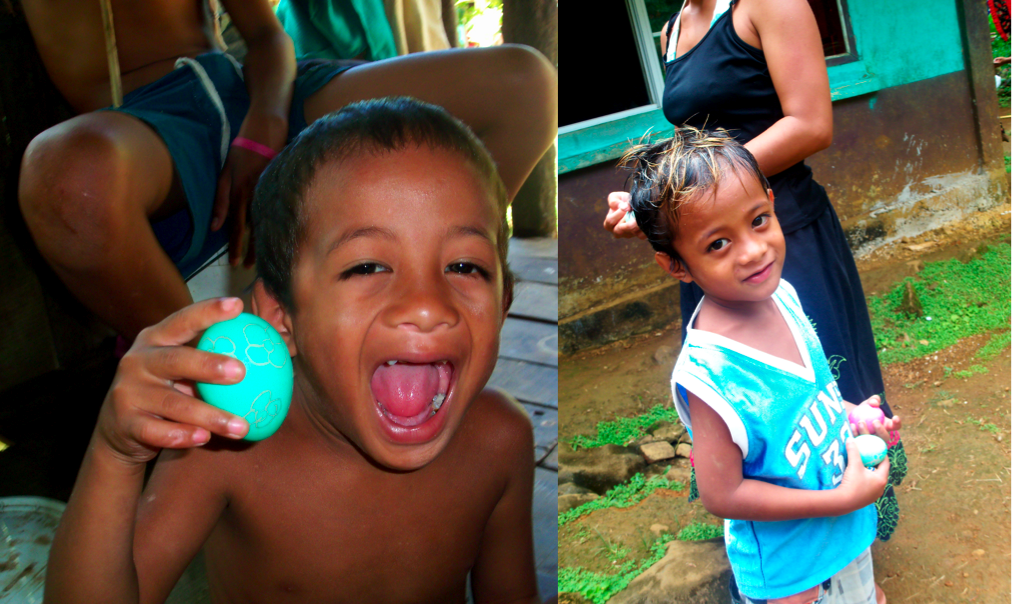
Once again, I added in my idea of Easter fun with an Easter egg hunt for the kids. It was a blast.

Showing off their findings
Easter marked my last major holiday in Pohnpei. Things are definitely drawing to a close. Easter also showed me how long I've been here - I compared photos from last year and this year to see how the kids have grown: